Lemonade
Our pick for overall value for dachshund puppies
Est. monthly$22–$45
Read reviewIntervertebral disc disease strikes 19–24% of dachshunds and costs $6,000–$10,000 to treat surgically. Comprehensive plans typically cover it, but generally only if you enroll before the first vet note about your dog's back.
Written by Allen Lee · Last updated August 18, 2026 · 8 carriers tracked
Advertiser disclosure: DachshundInsurance.com is an independent comparison website — not an insurance company, agency, or producer. We do not sell, issue, or bind policies. We may earn a commission when you click carrier links, at no cost to you. Learn more about our review process.
Typically yes. The comprehensive accident-and-illness plans we track list intervertebral disc disease as an eligible condition, provided it is not pre-existing when you enroll and the policy's waiting period has passed.
Coverage varies by insurer and policy, and every claim is subject to the policy's terms, exclusions, and waiting periods. Accident-only plans generally do not include disc disease. Always confirm the details in the carrier's sample policy before you buy.
Last reviewed August 2026 · Based on the published policy documents of the 8 carriers we track. Coverage varies by insurer, state, and policy version.
Intervertebral disc disease is the premature hardening and rupture of the shock-absorbing discs between the vertebrae. Dachshunds are chondrodystrophic, they carry the FGF4 retrogene that produces short legs and a long back, and it also causes disc mineralisation as early as age one. When a hardened disc bursts, it presses on the spinal cord and causes pain, wobbliness, or paralysis within hours.
Roughly 19–24% of dachshunds have at least one IVDD episode in their lifetime, about ten times the rate of the average dog. Most cases appear between ages 3 and 7, which is exactly when uninsured owners get caught out.

Vets grade IVDD from 1 to 5. The grade decides whether your dachshund needs crate rest or emergency surgery, and it moves the bill by an order of magnitude. Comprehensive plans typically cover the treatments below, subject to each policy's terms, exclusions, and waiting periods.
| Grade | Signs | Usual treatment | Typical cost | Outlook |
|---|---|---|---|---|
| Grade 1 | Pain only, no weakness | Crate rest + meds | $500–$1,500 | Excellent with strict rest |
| Grade 2 | Wobbly, walks but drags | Rest or surgery | $1,500–$7,000 | Very good |
| Grade 3 | Cannot walk, can move legs | Surgery advised | $6,000–$9,000 | 90%+ with prompt surgery |
| Grade 4 | Paralysed, can feel toes | Surgery urgent | $7,000–$10,000 | ~90% within 24 hrs |
| Grade 5 | Paralysed, no deep pain | Emergency surgery | $8,000–$12,000 | 50–60% if operated <24 hrs |
More detail on each stage in our dachshund IVDD health guide, and a full price breakdown in the IVDD surgery cost guide.
Outcomes in dachshund disc disease are decided in hours, not days. Below is a general sequence commonly described in published veterinary sources, follow your own veterinarian's instructions first.
No stairs, no jumping, no walks. Carry your dachshund with one hand under the chest and one under the hips. Movement after a disc ruptures is what turns a Grade 2 into a Grade 4.
Pinch a back toe firmly. If your dog turns and reacts, sensation is present. No reaction is a Grade 5 emergency, surgery within 24 hours roughly doubles the odds of walking again.
General practices cannot perform an MRI or a hemilaminectomy overnight. Ask specifically for a facility with advanced imaging before you drive.
Photograph the invoice and the vet's notes, and file while the episode is active. Delayed filings are the most common avoidable reason a legitimate IVDD claim stalls.
Ibuprofen and paracetamol are toxic to dogs and can complicate the steroids or NSAIDs the neurologist will want to use.
Educational information only, not veterinary advice. Always follow your treating veterinarian's guidance.
| Carrier | IVDD / orthopedic wait | Max annual payout | Note |
|---|---|---|---|
| Healthy Paws | 15 days | Unlimited | Our top pick for IVDD coverage |
| Trupanion | 30 days | Unlimited | Can pay participating vets directly |
| Spot | 14 days | Up to unlimited | No upper enrollment age |
| Pumpkin | 14 days | Up to $20,000/yr | Lists dental illness as eligible |
| Fetch | 15 days | Up to $15,000/yr | Covers exam fees |
| ASPCA | 14 days | Up to unlimited | Flexible deductible options |
| Lemonade | 6 months | Up to $100,000/yr | Lowest quoted premium in our comparison; long ortho wait |
| Embrace | 6 months (waivable) | Up to $30,000/yr | Waive with a clean ortho exam |
Waiting periods, payout caps, and covered conditions vary by insurer, state, and policy version. Please verify the details directly with the carrier and review their current sample policy before enrolling.
Plan details, prices, ratings and "best for" labels on this page are our own editorial opinion, based on publicly available plan documents and marketing materials at the time of writing. They are not quotes, endorsements, or statements made by the insurers. Terms, pricing, waiting periods, exclusions and state availability vary by insurer and policy and can change at any time — always confirm current details in the carrier's own policy documents. Company and product names are the trademarks of their respective owners and are used here for identification only; use does not imply affiliation or endorsement, except where an affiliate relationship is disclosed. Spot an inaccuracy? Tell us and we'll correct it.
About these carrier comparisons: Plan details, prices, ratings and "best for" labels on this page are our own editorial opinion, based on publicly available plan documents and marketing materials at the time of writing. They are not quotes, endorsements, or statements made by the insurers. Terms, pricing, waiting periods, exclusions and state availability vary by insurer and policy and can change at any time — always confirm current details in the carrier's own policy documents. Company and product names are the trademarks of their respective owners and are used here for identification only; use does not imply affiliation or endorsement, except where an affiliate relationship is disclosed. Spot an inaccuracy? Tell us and we'll correct it.
The goal of insurance isn't just paperwork. It's being able to say "yes" to MRI, surgery, and rehab the same day your dachshund's back goes out, without a GoFundMe or a hard choice.
A comprehensive accident-and-illness plan can reimburse 80–90% of eligible vet bills after the deductible, subject to the policy's terms, waiting periods, and exclusions.
MRI or CT myelogram runs $1,800–$3,000. Hemilaminectomy decompression surgery adds $3,000–$5,000. Hospitalization for two to five nights is $800–$2,000, and rehabilitation costs another $1,000–$3,000. With an 80% reimbursement plan and a $250 deductible, an $8,000 episode costs an insured owner roughly $1,800 out of pocket instead of $8,000.
| Emergency exam & neuro consult | $150–$400 |
| MRI or CT myelogram | $1,800–$3,000 |
| Hemilaminectomy decompression surgery | $3,000–$5,000 |
| Hospitalisation, 2–5 nights | $800–$2,000 |
| Medication & bladder management | $200–$600 |
| Rehabilitation / hydrotherapy | $1,000–$3,000 |
| Typical all-in surgical episode | $6,000–$10,000 |
At 90% reimbursement with a $250 deductible your share drops to roughly $1,025. Estimates only, your quote depends on ZIP code, age, and plan settings. Run your own numbers in our dachshund insurance cost calculator.
Estimates only. Actual reimbursement depends on the carrier's fee schedule, annual limits, and whether the condition is pre-existing. Verify terms with the insurer before enrolling.
Advertiser disclosure — we may earn a commission.
Insurers read your dachshund's full medical history. A single note reading "mild back stiffness" or "suspected disc discomfort" is enough to exclude IVDD for life on a new policy. This is why enrolling a dachshund puppy between 8 weeks and 6 months of age is the highest-value decision an owner can make.
Related: does pet insurance cover IVDD? · insuring a puppy vs. a senior dachshund
At $40/month for ten years you pay $4,800 in premiums. One IVDD surgery reimbursed at 80% returns roughly $6,200. For a breed with a one-in-four lifetime incidence rate, insurance is closer to expected-value neutral-to-positive than it is for almost any other breed, before counting the value of never choosing treatment based on cost.
This is the most expensive mistake dachshund owners make. A disc rupture is classified as an illness, not an accident, even when it happens mid-jump off the sofa. Accident-only policies, often the lowest-priced quote you will see, pay nothing toward IVDD. You need an accident-and-illness plan, with no per-condition cap and no hereditary-condition exclusion.
See how the eight carriers we track compare on payout caps and reimbursement in our best dachshund insurance comparison, or read the individual carrier reviews.
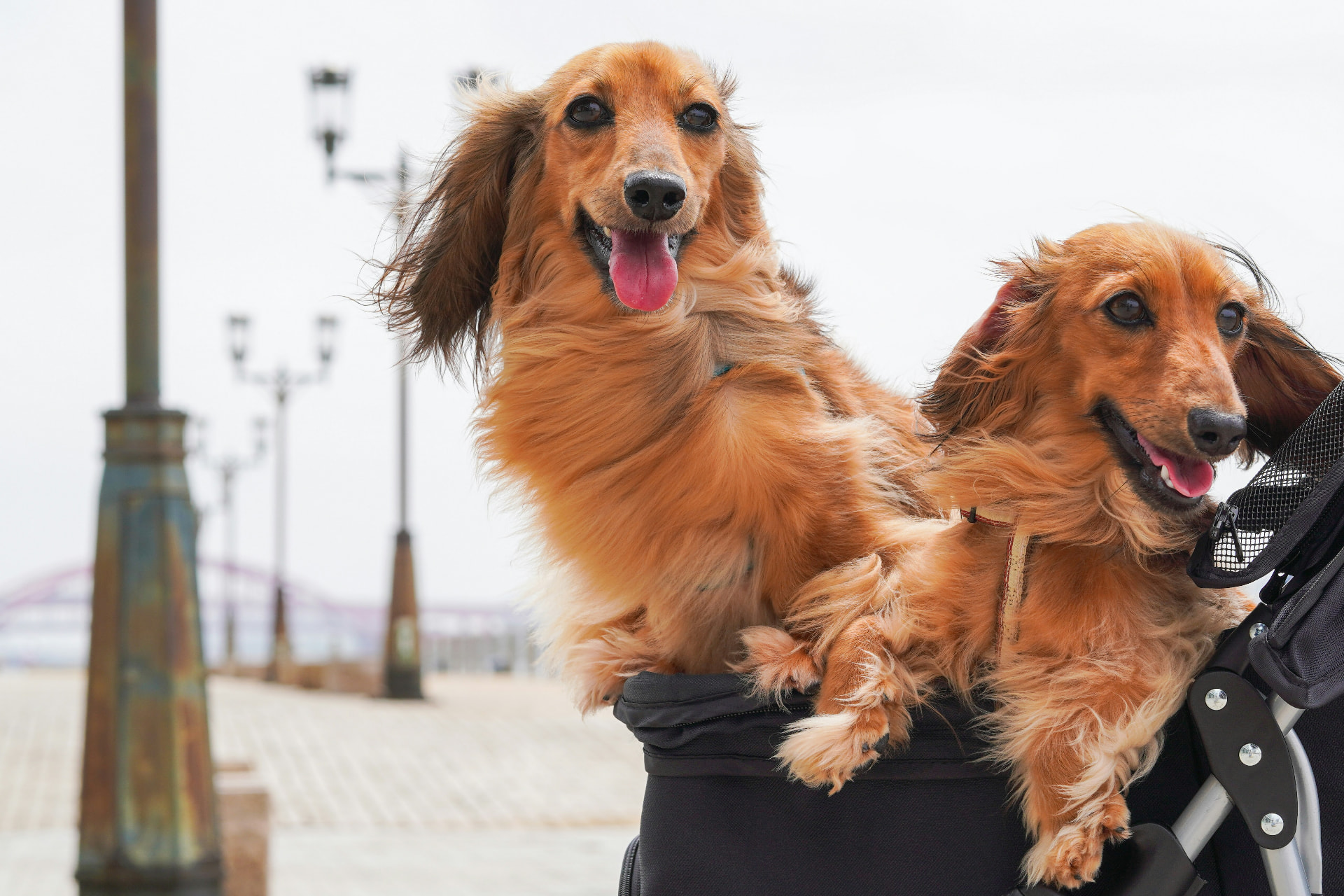
Recovery is measured in weeks of restricted movement, not days. A pet stroller, a sling, and a strict crate schedule do more for the outcome than anything else you can buy, and the rehab that goes with them is reimbursable on most plans.
You cannot breed the FGF4 gene out of a dog you already own, but you can change the mechanics around it. These six habits are the ones most often described in published veterinary literature and owner guidance.
Go deeper in our dachshund back problem prevention guide and weight management guide.
Our pick for overall value for dachshund puppies
Our pick for IVDD coverage; no payout caps published
Our pick for customizable coverage
Plan details, prices, ratings and "best for" labels on this page are our own editorial opinion, based on publicly available plan documents and marketing materials at the time of writing. They are not quotes, endorsements, or statements made by the insurers. Terms, pricing, waiting periods, exclusions and state availability vary by insurer and policy and can change at any time — always confirm current details in the carrier's own policy documents. Company and product names are the trademarks of their respective owners and are used here for identification only; use does not imply affiliation or endorsement, except where an affiliate relationship is disclosed. Spot an inaccuracy? Tell us and we'll correct it.
About these carrier comparisons: Plan details, prices, ratings and "best for" labels on this page are our own editorial opinion, based on publicly available plan documents and marketing materials at the time of writing. They are not quotes, endorsements, or statements made by the insurers. Terms, pricing, waiting periods, exclusions and state availability vary by insurer and policy and can change at any time — always confirm current details in the carrier's own policy documents. Company and product names are the trademarks of their respective owners and are used here for identification only; use does not imply affiliation or endorsement, except where an affiliate relationship is disclosed. Spot an inaccuracy? Tell us and we'll correct it.
Typically yes. Most comprehensive accident-and-illness plans list intervertebral disc disease as an eligible condition, as long as it is not pre-existing at enrollment and the waiting period has passed. Accident-only plans generally do not. Coverage varies by insurer and policy.
Emergency MRI plus decompression surgery costs $6,000–$10,000 in most U.S. metros, with $1,000–$3,000 more for post-operative rehabilitation. Conservative crate-rest management runs $500–$2,000.
Most carriers apply their standard 14–15 day illness waiting period. Lemonade applies a 6-month orthopedic waiting period, and Embrace applies a 6-month orthopedic waiting period that can be waived with a clean orthopedic exam within 30 days of enrollment.
You can usually insure the dog, but a diagnosed disc disease is typically excluded as pre-existing. Unrelated conditions generally remain eligible, and some carriers will reconsider conditions that stay symptom-free for 12–24 months. Confirm the specifics with the insurer.
For a dachshund, look for an unlimited annual payout, no per-condition cap, a short orthopedic waiting period, and 80–90% reimbursement. Based on their published policy documents, Healthy Paws and Trupanion line up well against those criteria, and Trupanion offers direct payment to participating vets. Compare current policy documents before you buy.
IVDD in dachshunds is linked to the chondrodystrophic FGF4 retrogene, so it is genetic in origin. The eight carriers we track state in their current accident-and-illness policy documents that hereditary and congenital conditions are eligible, so genetics alone does not usually void an IVDD claim, a pre-existing diagnosis is the common reason for denial. Terms and exclusions vary by policy.
Most carriers publish a standard 14–15 day illness waiting period, Trupanion publishes 30 days, and Lemonade and Embrace publish a 6-month orthopedic waiting period (Embrace states it can be waived with a clean orthopedic exam within 30 days). A disc episode inside the waiting period is generally treated as pre-existing. Check your policy for current terms.
Conservative management is often eligible too: the exam, imaging, steroids, muscle relaxants, gabapentin, and crate-rest rechecks are typically covered when vet-prescribed. Hydrotherapy, laser, and physical rehabilitation are included in the published plans of Trupanion, Healthy Paws, Spot, Pumpkin, Fetch, and ASPCA. Lemonade lists a physical-therapy add-on. Coverage is subject to policy terms and exclusions.
Usually yes, provided the first episode happened while insured and the policy stays continuously active, subject to the policy's terms and any payout limits. Because roughly 20% of surgically treated dachshunds herniate a second disc, be cautious with per-condition payout caps, which can be exhausted by episode one.
Between 8 weeks and 6 months. IVDD usually presents between ages 3 and 7, so a puppy policy usually clears the waiting periods years before the risk window and tends to lock in a lower premium band.
More answers on the dachshund insurance FAQ and in the dachshund health hub.
Cost ranges come from published U.S. specialty-hospital pricing and owner-reported invoices; incidence and prognosis figures come from the peer-reviewed veterinary literature below. Waiting periods, payout caps, and exclusions were read directly from each carrier's current sample policy in August 2026. Coverage varies by insurer, state, and policy version, always confirm terms before you buy.
Last reviewed August 2026. We earn a commission if you buy through our links, which never changes how carriers are ranked.
Get matched with the best IVDD coverage for your dachshund in under two minutes.
Advertiser disclosure — we may earn a commission.