Preventing Back Injuries in Dachshunds: Daily Habits
Ramps, a harness, lean weight, and the right kind of exercise, four daily habits that genuinely move the needle on IVDD risk.
Written by Allen Lee · Published March 18, 2026 · Last updated August 18, 2026
Quick answer
You can't change your dachshund's genetics, but you can stack the deck: ramps instead of jumps, a Y-front harness, controlled exercise, and a lean body. None of these costs more than a single vet visit, and together they meaningfully lower IVDD risk.
Key facts
- Lever 1
- Lean body condition
- Lever 2
- Ramps, never jumps
- Lever 3
- Y-front harness
- Lever 4
- Controlled exercise
- Highest-risk moment
- Jumping off furniture
Use ramps and steps everywhere
Every jump off a couch is a compression event on the spine, and the landing is worse than the takeoff. Install ramps for beds and couches, use pet stairs for the car, and place a non-slip runner on hard flooring where your dachshund turns at speed. Train early, a puppy that grows up using ramps will not fight them as an adult. Reward ramp use with the same treat you would use for any other trained behaviour.
Switch to a harness
Collars concentrate force on the cervical vertebrae, and cervical disc disease accounts for a meaningful share of dachshund IVDD cases. A well-fitted Y-front harness distributes pull across the chest and shoulders without restricting the shoulder joint. Look for options cut for long-backed breeds, and check fit every few months on a growing puppy.
Controlled exercise, not restriction
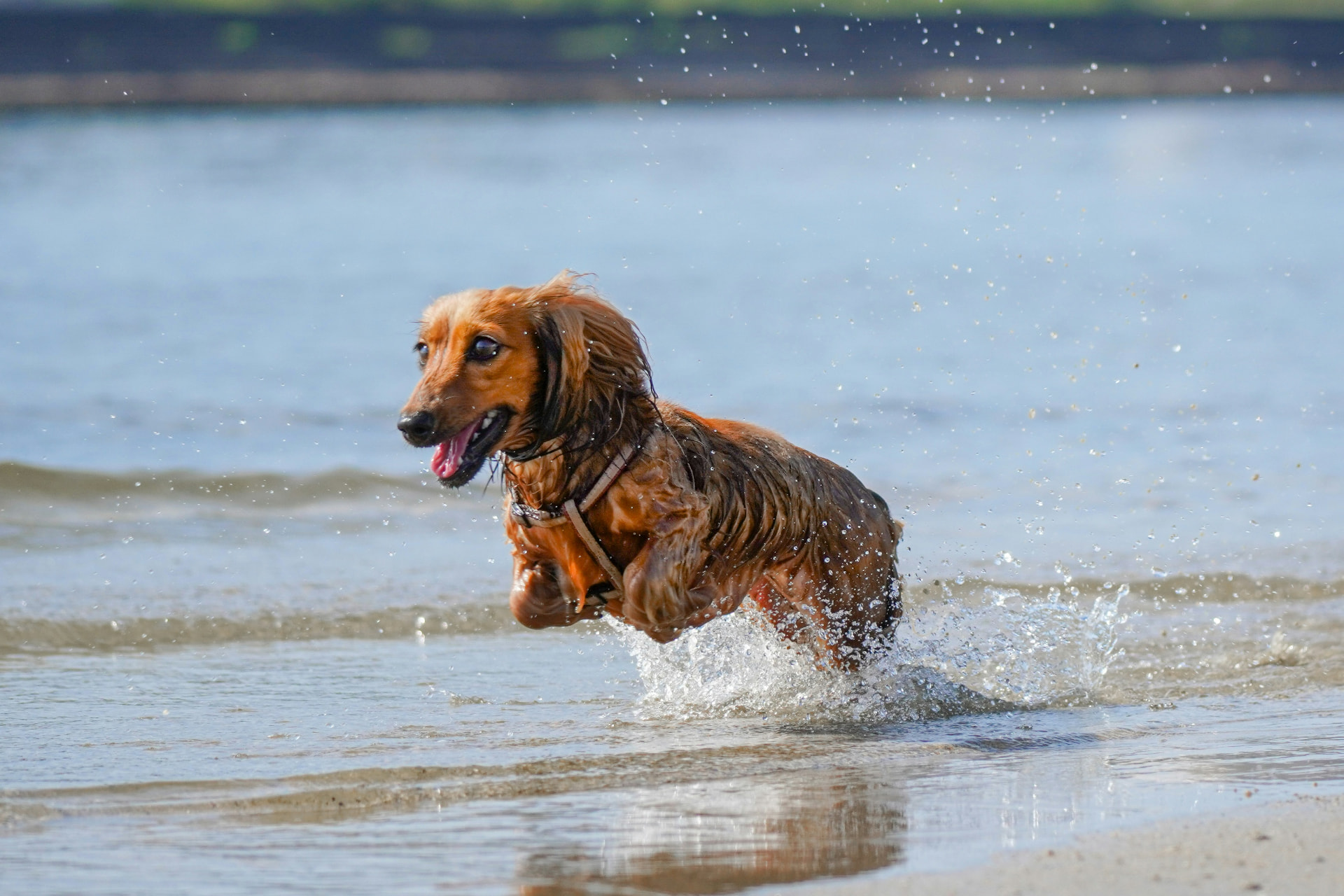
The goal is a strong core, not a sedentary dog. Swimming, gentle leash walks on varied terrain, sniff-walks, and puzzle toys are ideal. Skip agility jumps, aggressive tug-of-war, rough play with larger dogs, and unrestricted fetch on hard surfaces where the dog twists and brakes. A canine physical therapist can build a structured strengthening program, worth the two-session investment for any dachshund with a family history of back problems.
Keep the weight off
Lean body condition is the highest-value habit on this list. Overweight dachshunds experience 2–3x more IVDD episodes and recover more slowly. Aim for a body condition score of 4–5 out of 9, measure food with a scale, and count treats as calories. See our dachshund weight guide for a safe reduction plan.
Handle and lift correctly
Always support the chest and the hindquarters together, keeping the spine horizontal, never lift under the front legs alone and let the back end dangle. Teach children the two-hand lift before they ever pick the dog up. Discourage begging positions that hold the dog upright on its hind legs for long stretches.
Insure before symptoms, not after
Prevention lowers risk; it does not eliminate it. Because a single vet note about back stiffness can make IVDD pre-existing for life, the financial half of prevention is enrolling in a comprehensive plan while the record is clean. Compare plans that publish unlimited annual payouts if you want coverage that survives repeat episodes. Coverage varies by insurer and policy.
Set the house up before the injury
The least expensive spine surgery is the one you never buy. Ramps at the couch and bed remove the highest-force landing your dachshund performs daily, the drop from furniture, where the front legs absorb the impact and the mid-back flexes hard. Baby gates at stairs matter for the same reason. Non-slip runners over hardwood stop the splayed-leg scramble that torques the lumbar spine, and a Y-front harness distributes leash pressure across the chest instead of the neck. None of this is exotic; it is a weekend and a couple hundred dollars against a five-figure risk.
Exercise that strengthens rather than stresses
Dachshunds need conditioning, not restriction. Flat leash walks, swimming, and slow controlled sniff-walks build the paraspinal and core muscles that stabilize the spine. Skip repetitive ball chasing on slick floors, jumping for frisbees, agility jumps, and rough wrestling with larger dogs. Cavaletti-style step-overs and gentle sit-to-stand repetitions, ideally demonstrated once by a certified canine rehab practitioner, are the two exercises most commonly recommended for back-sensitive dogs. Build duration gradually and stop at the first sign of a tired, dipping topline.
Early signals worth a same-week vet visit
Prevention includes catching trouble at the whisper stage. Hesitating before a jump they used to make, a hunched topline, a stiff-legged trot, flinching when lifted, or simply choosing to lie in the hallway instead of climbing onto the couch, those are behavior changes, not personality changes. Getting an exam while the dog is still a grade 1 generally gives you the least expensive and least invasive version of treatment. Waiting until the hind legs drag turns a $600 problem into a $9,000 one, see the full IVDD surgery cost breakdown.
Frequently asked questions
Should dachshunds be allowed to use stairs?
Most veterinary sources advise limiting stair use, especially descending, and blocking access with a gate for puppies and any dog with a back history.
Is a harness or a collar better for a dachshund?
A Y-front harness is generally recommended because it moves pulling force off the neck vertebrae and distributes it across the chest.
Can prevention stop IVDD entirely?
No. IVDD in dachshunds is largely genetic. Prevention reduces the frequency and severity of episodes, which is why insurance and prevention work together rather than as alternatives.
Do ramps really prevent IVDD in dachshunds?
Ramps cannot override the genetic disc degeneration this breed carries, but they remove repeated high-impact loading on the spine, which is a recognized risk factor. Most veterinary neurologists recommend them alongside weight control as standard household practice for dachshunds.
Should dachshunds be allowed to climb stairs?
Many owners restrict stairs entirely, especially going down, where the front end absorbs most of the load. If stairs are unavoidable, carrying your dog or installing a gate is the common recommendation for dogs with any history of back sensitivity.
Sources
Make sure your dachshund is covered before you need it.
Compare the plans that cover IVDD for dachshunds in under two minutes.
Advertiser disclosure — we may earn a commission.